The Galapagos Islands are one of the greatest treasures we can find in
the Pacific Ocean. The islands are also called “Colon Archipelago”, its capital
is Puerto Baquerizo Moreno.
The Galapagos Islands are one of the greatest treasures we can find in
the Pacific Ocean. The islands are also called “Colon Archipelago”, its capital
is Puerto Baquerizo Moreno.
The Enchanted Islands, the archipelago designation earned in the
sixteenth century by the great biodiversity of flora and fauna for generations
inheriting the name, are 19 islands and hundreds of small islands where life
takes on a special dimension, known in the whole world by its endemic and
studies by Darwin's theory of evolution species.
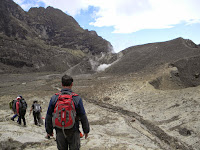
The archipelago is one of the most active volcanic groups in the world.
Many of the islands are only the tips of some volcanoes and show an advanced
state of erosion.
A study in 1952 by historians Thor Heyerdahl and Arne Skjolsvold,
ceramics revealed that some people may find Incas before the arrival of the
Spaniards, however there were no graves, vessels and to disclose any old
building settlements before colonization.
On March 10, 1535 -discovered by the Bishop of Panama Tomás de Berlanga-
while traveling from Panama to Peru along the west coast of South America, wind
and ocean currents gradually pushed the boat too westward reaching what we now
know as the Galapagos Islands.
In a letter to the King of Spain -Tomás de Berlanga- recounts his
arrival in the islands:
"Once the boat docked, we all went down and some of the crew were
given the job of making a well and others were sent to get water inside the
Island. Within the Island men could not find a single drop of water for two
days.
The thirst was too much and as a last resort people attended a similar
fruits prickly pears, and juicy as they were somewhat, but not very tasty, we
started eating them, and squeezing out to extract as much water as possible and
men drank of this fruit."
The Galapagos were used as a hideout for English pirates on their trips
to plunder Spanish galleons carrying gold and silver from America to Spain. The
first recorded pirate who visited the islands was Englishman Richard Hawkins in
1593. Since then many pirates came to the archipel.
An interesting anecdote in the history of the Galapagos Islands was when
Alexander Selkirk, whose adventures in the Islands "Juan Fernandez"
inspired Daniel Defoe to write the novel Robinson Crusoe, visited the Galápagos
in 1708 after it was rescued from Juan Fernandez Woodes Rogers.
Rogers was fixing their boats in the Galapagos after looting the city of
Guayaquil in Ecuador.
The first scientific mission arrived in Galapagos in 1790 under the
leadership of Alessandro Malaspina, who was a Sicilian captain whose expedition
was sponsored by the King of Spain. But this expedition records were lost.
 In the seventeenth century is beginning to populate the area when the
navigator James Colnett describes the place as some islands rich in flora and
fauna, which attracted the first settlers, mostly English, with interest in
whales, sea lions and mainly for the Galapagos tortoises to extract their fat,
fat discovery of sperm whales also attracted many whalers which led to a
makeshift post office where boats left and collected letters believed.
In the seventeenth century is beginning to populate the area when the
navigator James Colnett describes the place as some islands rich in flora and
fauna, which attracted the first settlers, mostly English, with interest in
whales, sea lions and mainly for the Galapagos tortoises to extract their fat,
fat discovery of sperm whales also attracted many whalers which led to a
makeshift post office where boats left and collected letters believed.
Ecuador annexed the Galápagos Islands on February 12, 1832 under the
government of General Juan José Flores, baptizing as “Colon Archipelago”.
The September 15, 1835 the ship Beagle brought aboard the British
expedition under the command of Captain Robert Fitz Roy Galapagos to
investigate isolated places hardly visited by boaters. This list of places
include Valparaiso, Callao, Galapagos Islands, Tahiti, New Zealand, Australia,
Cape of Good Hope and anchored back in Falmouth on October 2, 1836. The captain
and others on board, including the young naturalist Charles Darwin made a scientific study of geology and biology on four of
the islands before continuing his expedition around the world. The ship
remained afloat for 5 weeks in the islands, but Darwin was on the ground just for
two weeks, there investigated animals from the region would lead in the future
to make Darwin's Origin of Species.
An Irish man named Patrick Watkins was a hermit and was the first person
who lived in the Galapagos Islands, specifically on Floreana Island in 1807.
Watkins lived alone and was famous for providing vegetables to the
whalers in exchange for Ron for many years until he left the island in an
unknown direction.
Then the General José Villamil arrived in 1832. Villamil (Ecuadorian
general) founded a penal colony for political prisoners and common criminals
who exchanged meat and vegetables with the whalers.
In the late twenties Dr. Friedrich Ritter arrived at the Islands with
his wife. The story says he extracted his teeth before going to Galapagos to
avoid having to take them off after it.
The second group were the Wittmer´s, a family from the city of Cologne
in Germany.
The final group and one of the most talked about were three lovers who
escorted the Baroness von Wagner Bosquet who had plans to build a luxury hotel.
The earlier settlers were appalled at the arrival of this new character
who later called himself "Empress of Floreana".
But the story ends on a mystery as all settlers from Mrs. Strauch Doer
and the Wittmer family began to fade and die along with Dr. Ritter who died
eating poisoned meat which was very strange because he was a vegetarian.
The Baroness also disappeared with one of her 3 lovers.
A book published in 1961 and was a best seller is based on the life of
Margaret Wittmer who was one of the oldest survivors of the Galapagos. She died
in 2000 aged 95.
ENDEMIC SPECIES
Endemic reptiles
Galapagos tortoise
• Previously there were 14 species of Galapagos tortoises, three became
extinct in the nineteenth century and ended on June 24, 2012, with its last
issue “Lonesome George”.
There are still ten species of giant tortoises (Galapagos turtle or
terrapin) belonging to the genus Chelonoidis.
• Land iguanas (Conolophus subcristatus, Conolophus Conolophus pallidus
and pink).
• The marine iguana (Amblyrhynchus cristatus), the only species of
iguana that seeks its food in the sea.
Endemic mammals
• Galapagos Sea Lion Galapagos sea lion or (Zalophus wollebaeki), related
to the California sea lion (also described as Zalophus californianus wollebaeki,
a subspecies of the California sea lion).
• Lobo furrier or fur seals Galapagos Galapagos (Arctocephalus
galapagoensis), which is the world's smallest (Salazar 2002).
Endemic Bird
Galapagos Penguins
• Lava Gull (Larus fuliginosus).
• 13 endemic species of finches, of which the best known is a kind of
vampire bird that feeds on the blood of infected birds and is known as Darwin's
finches, which inhabits the most northern island of the archipelago named Wolf.
• Galapagos penguin or booby of the Galapagos (Spheniscus mendiculus),
the only penguin species that has been recorded in the northern hemisphere, in
the northern part of Isabela Island.
• Cormorant or Galapagos Cormorant (Phalacrocorax harrisi).
• Kestrel or the Galapagos hawk (Buteo galapagoensis).
• dwarf Galapagos Heron (Butorides sundevalli).
• Waved Albatross (Phoebastria irrorata).
• Leg stuck (Pterodroma phaeopygia).
• Burrito Galapagos (Laterallus spilonotus).