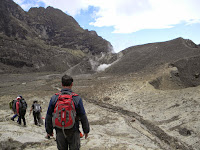
EDWARD WHYMPER in the Ecuadorian Andes
EDWARD WHYMPER - British traveler and explorer
(London, 1840 - Chamonix, 1911)
He made his first ascents,
conducted with a group of climbers, for illustration of an attempt to climb
Mont Pelvoux. Once he was passionate about the mountains he made a series of
climbs that improved knowledge about the Dauphiné Alps, the Pennines and the
Montblanc Massif. After some failures he managed to reach for the first time on
July 14, 1865, on the summit of famous Swiss Matterhorn, a victory that cost
the lives of four of his colleagues. The narration of such attempts is the
largest part of his book “Climbing in the Alps”, published and illustrated by
himself in 1871.
Some years later during an
expedition to the Andes of Ecuador he ascended first Chimborazo (6310m) and
other major peaks. He left the story of this new venture by the Great Travel
Andes of Ecuador (1892). He conducted a final expedition to the Rocky Mountains
of Canada (1901-1905).
In Ecuador
Whymper next organized an
expedition to Ecuador, designed primarily to collect data for the study of
altitude sickness and the effect of reduced pressure on the human body. His
chief guide was Jean-Antoine Carrel, who later died from exhaustion on the Matterhorn
after bringing his employers into safety through a snowstorm. During 1880,
Whymper made two ascents of Chimborazo (6,267m), also claiming the first
ascent. He spent a night on the summit of Cotopaxi and made first ascents of
half a dozen other great peaks. In 1892, he published the results of his
journey in a volume entitled “Travels amongst the Great Andes of the Equator”. His
observations on altitude sickness led him to conclude that it was caused by a
reduction in atmospheric pressure, which lessens the value of inhaled air, and
by expansion of the air or gas within the body, causing pressure upon the
internal organs. The effects produced by gas expansion may be temporary and
dissipate when equilibrium has been restored between the internal and external
pressure. The publication of his work was recognized on the part of the Royal
Geographical Society by the award of the Patron's medal. His experiences in
South America having convinced him of certain serious errors in the readings of
aneroid barometers at high altitudes, he published a work entitled “How to Use
the Aneroid Barometer” and succeeded in introducing important improvements in
their construction. He afterwards published two guide books to Zermatt and
Chamonix.
The Ecuador expedition summarized:
1879
09th of December Landing
in Guayaquil
13th-17th
of December Travel to Chimborazo
21st of December he found out that Chimborazo has
two peaks
1880
04th of January Summit of Chimborazo
06th of January Summit of Chimborazo (highest
point on Earth 6300m)
After some weeks of relaxation
next project were:
08th of February Summit of Illinizas
17th of February Summit of Cotopaxi
18/19th of February Observation of the Vulcano Crater
Until March Observation of Cotopaxi
Nationalpark
02nd of March Back in Quito
03rd of March Whymper received
presidential greeting
04th of March New goal is the Antisana
Mountain
10th of March Summit of Antisana
21-23st of March Rucu y Guagua Pichincha
01st of April Summit of Cayambe
In the following weeks and
months he climbed Altar, again Chimborazo and Cotopaxi
Back in EUROPE
Back in Europe and dedicated to
spice up his notes of travel, and had considered as one of the largest elevator
operators in the world, lived in his hometown, but every summer he went Alpine
climbing.
Between 1900 and 1903 he visited
the Rocky Mountains of the United States by invitation of the "Canadian
Pacific Railway", accompanied by six experienced guides but without attempting
ascents.
On 25 April 1906 with nearly
sixty years, he married Marie Edith Lewin, just twenty years old and they had a
daughter named Ethel who inherited his father's gifts, periodically updating
the Alpine Guides of authorship.
In 1910 he learned of attempts
to climb the highest peaks of the Himalayas that exceeded their exploits. The
character has soured considerably as a result of premature senile neurosis, to
the point that his wife and daughter living apart from him.
In August 1911 he undertook his
annual trip to the Alps. In September he suffered in the town of Chamonix/France
of illness, locked in his room refused all help, where he died on 16th
of September 1971.
He established himself as one
of the greatest climbers and mountaineers of all time.
Tall, muscular, hardened by the
character and the sun in his face, his regular features gave him a severe
juvenile poise, blue eyes, blonde – later grey hair. He was the prototype of
the Anglo-nineteenth century. In 1921 his book was translated into Spanish by
Professor Bahamonde and 1993 published in full, with the title "Travel
through the majestic Andes of Ecuador".